Dental Implants in Nottingham: Costs, Process, Risks and Recovery
A clinically reviewed guide to dental implants in Nottingham, covering consultation scans, surgery, pain relief, recovery, risks, costs, finance and NHS availability.
What is a dental implant?
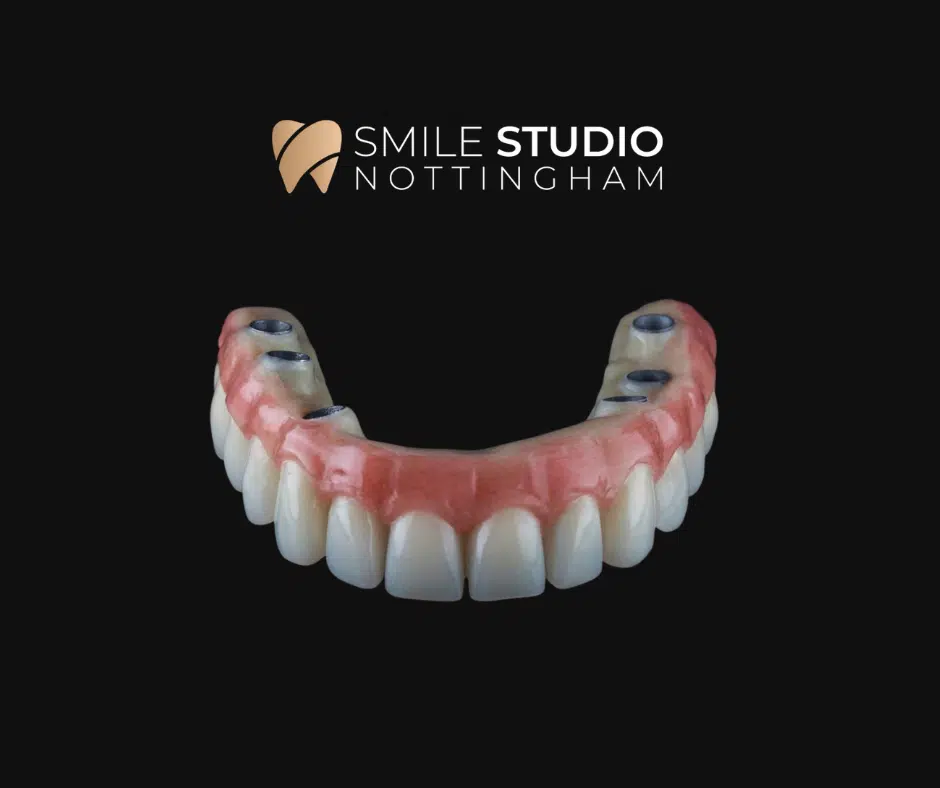
At Smile Studio in Arnold, implant options include single-tooth implants, implant bridges, All-on-4 or All-on-6 full-arch treatment and implant-retained dentures. Suitability cannot be decided from a photograph alone.
Dental implant options compared
| Option | Replaces | Removable? | Typical treatment complexity | Published price |
|---|---|---|---|---|
| Single implant and crown | One tooth | No | Assessment, implant placement, healing, crown | From £1,950 to £2,500 depending on restoration |
| Implant bridge | Several adjacent teeth | No | Multiple implants and bridge planning | 3-unit implant bridge £3,950 |
| Implant-retained denture | Multiple or all teeth | Yes | Implants plus removable overdenture | From £2,000 |
| All-on-4 / All-on-6 | Full arch | Usually fixed by clinician | Advanced full-arch planning and surgery | Individual quotation |
What happens during an implant consultation?
Medical and dental assessment
Your implant clinician reviews health conditions, medicines, smoking, gum health, bite, existing teeth and the history of tooth loss.
Scans and records
Investigations can include dental X-rays, photographs, digital scans and a 3D CBCT scan to assess bone volume and important anatomy. A CBCT is used only where clinically justified.
Alternative options
The discussion should include no treatment, a removable denture, a conventional bridge, an adhesive bridge or retaining a tooth where predictable.
Consent and planning
You should receive a written plan covering stages, risks, likely timescale, provisional teeth, total costs and maintenance.
Step-by-step implant process
Stabilise oral health
Gum disease, decay and active infection should be controlled before implant placement.
Planning and anaesthetic
Implants are commonly placed under local anaesthetic. Sedation may be considered for suitable nervous patients or complex procedures after assessment.
Implant placement
The gum is opened, the bone is prepared and the implant is placed. Stitches may be used. A single straightforward placement may take roughly 30 to 90 minutes, while grafting or full-arch surgery can take longer.
Healing
Osseointegration commonly requires several months. Guy’s and St Thomas’ notes that at least three months may be required before loading in many cases.
Final restoration
Scans or impressions are taken and the crown, bridge or denture is fitted and checked.
Appointment count: commonly several visits across 3 to 12 months. Bone grafting, extractions and full-arch treatment can change this substantially.
Recovery, pain control and eating
Local anaesthetic should prevent pain during surgery, although pressure and vibration may be felt. Soreness, swelling, bruising and minor bleeding can occur afterwards. Follow the personalised instructions from your implant team.
- Use recommended pain relief only if safe for you and according to instructions.
- Choose cooler, softer foods initially and avoid chewing directly on the surgical area.
- Avoid smoking and alcohol during healing as advised.
- Do not disturb stitches or brush the surgical site until instructed.
- Attend the planned review, often within 7 to 14 days.

Dental implant risks and limitations
Failure to integrate
An implant may not fuse with bone and may need removal. Smoking and uncontrolled disease can increase risk.
Infection and peri-implant disease
Plaque-related inflammation can damage the supporting tissues if cleaning and maintenance are poor.
Nerve or sinus complications
Implants near nerves or the sinus require careful imaging and planning. Altered sensation can be temporary or, rarely, persistent.
Mechanical wear
Screws, clips, crowns or dentures can loosen, chip or wear and require maintenance.
Bone graft morbidity
Grafting can add swelling, bruising, discomfort, cost and healing time.
No lifetime guarantee
Implants are long-lasting, not indestructible. Health, cleaning, bite forces and attendance affect longevity.
Lifespan, maintenance and expected results
Implants can provide stable tooth replacement and avoid preparing neighbouring teeth in some cases. The implant fixture may remain in function for many years, but the crown, bridge, denture teeth, clips or screws can require repair or replacement. Maintenance includes meticulous home cleaning, professional reviews and monitoring of the gums, bite and bone levels.
Clinical review point: implant outcomes depend on diagnosis, restorative planning and long-term maintenance as well as surgery.
Proposed reviewer: Tanzeel Ahmad, Implant Surgeon. Approval required before publication.Cost, finance and NHS availability
Price is influenced by the number of implants, restoration type, scans, extractions, temporary teeth, sedation, bone grafting and laboratory design. Smile Studio publishes a £60 implant consultation, single implant and crown from £1,950, dental implant and zirconia crown from £2,500, implant-retained dentures from £2,000 and a 3-unit implant bridge at £3,950.
NHS implants are rare and generally reserved for specific priority circumstances, such as severe trauma, cancer rehabilitation or certain developmental conditions. Most routine implant treatment is private. Smile Studio advertises 0% finance for 12 months, subject to approval and terms.
Implant myths versus reality
| Myth | Reality |
|---|---|
| Implants are painless and instant for everyone | Local anaesthetic controls operative pain, but surgery and healing are still involved and timing varies. |
| Implants cannot fail | Failure, infection and mechanical complications are possible. |
| Implants need no cleaning | They require excellent daily cleaning and professional maintenance. |
| Everyone has enough bone | Some patients need grafting or a different treatment plan. |
Key takeaways
- A proper implant consultation may include X-rays, digital scans and CBCT imaging.
- Treatment usually involves multiple stages over months, not one appointment.
- Local anaesthetic is standard; sedation is case-dependent.
- Implants require lifelong cleaning, reviews and occasional component maintenance.
- NHS provision is uncommon for routine missing teeth.
Frequently asked questions
How painful are dental implants?
Local anaesthetic is used during placement. Most patients report postoperative soreness and swelling rather than pain during the procedure.
How many appointments do implants need?
Usually several appointments are required for assessment, scans, surgery, review, impressions or scans and final restoration.
How long does implant treatment take?
Straightforward treatment may take several months. Complex cases with grafting can take 6 to 12 months or longer.
Can smokers have implants?
Some smokers can be treated, but smoking increases complication and failure risks. The clinician may recommend stopping before treatment.
Are implants available on the NHS?
Only rarely, generally for defined high-priority clinical circumstances. Routine implant treatment is usually private.
What can I eat after implant surgery?
Softer foods are usually recommended initially. Follow your clinician’s exact advice and avoid disturbing the surgical area.
Related Smile Studio treatments and guides
Sources used for this guide
- NHS: Dental treatments
- Guy’s and St Thomas’: Dental implants overview
- Guy’s and St Thomas’: After dental implants
- Cambridge University Hospitals: Dental implants in restorative dentistry
- Smile Studio: Dental implants Nottingham
- Smile Studio: Pricing
External links are provided for general patient information. They do not replace advice from a dentist who has examined you.
Get a personalised assessment in Nottingham.
Smile Studio is at 152-156 Front Street, Arnold, Nottingham, NG5 7EG, with an on-site dental laboratory and Saturday appointments.